Ⅰ. LoRa: The Long-Range, Low-Power Sentry for Building Perimeters
In the evolution of Building Management Systems (BMS) from wired interconnection to wireless intelligence, communication technology has always been the core support. Traditional wired deployment faces pain points such as high construction costs, difficulties in retrofitting old buildings, and insufficient flexibility. In contrast, four major wireless technologies—LoRa, NB-IoT, ZigBee, and 5G—with their differentiated characteristics, precisely adapt to the diversified scenarios of building automation. They build a wireless communication network featuring "seamless sensing and fully interconnected control", serving as a key cornerstone for the implementation of smart buildings.
Ⅰ. LoRa: The "Long-Range, Low-Power Sentry" for Building Perimeters
LoRa (Long Range Radio) adopts spread spectrum communication technology, and its core advantages lie in a transmission distance of 1–15 kilometers and microwatt-level power consumption. A single lithium battery can support sensors to work continuously for 3–5 years. These technical characteristics make LoRa the optimal solution for building "peripheral spaces", focusing on adapting to large-scale data collection scenarios with non-real-time and low data rate requirements. Its typical application scenarios in building automation include:
Underground garage management: Deploy LoRa parking space detectors to collect real-time parking space occupancy status, which is uploaded to the BMS through gateways. It links with guide screens to realize parking space navigation, reducing deployment costs compared with traditional wired detectors.
Operation and maintenance of park public areas: Install LoRa modules in outdoor street lamps, irrigation equipment, and security cameras (low bit rate) in building perimeters to achieve remote dimming, valve control, and fault alarms, improving the operation and maintenance efficiency of public areas.
Retrofitting of old buildings: For old buildings without pre-embedded pipelines, LoRa connects scattered temperature and humidity sensors and energy meters, enabling access to the new BMS without wall-breaking and wiring, thus shortening the renovation cycle.
Ⅱ. NB-IoT: The "Massive Connection Steward" for Large-Scale Buildings
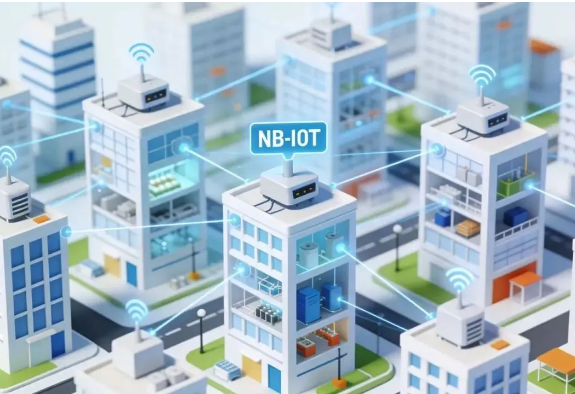
NB-IoT is a carrier-led narrowband Internet of Things technology. Leveraging cellular networks, it achieves wide-area coverage with the ability to penetrate 3–5 indoor floors. A single base station can connect up to 100,000 terminals simultaneously, with power consumption comparable to that of LoRa. Its core advantages lie in stable large-scale deployment and the convenience of no need for self-built gateways, supporting seamless integration with building automation protocols such as BACnet and Modbus.
The large-scale advantages of NB-IoT make it the core communication solution for large scenarios including commercial complexes and industrial parks, with typical applications as follows:
Energy Consumption Measurement and MonitoringDeploy NB-IoT smart electricity meters, water meters, and heat meters on each floor of office buildings and shopping malls. These meters upload sub-item energy consumption data to the BMS in real time, generating peak-valley load curves. This provides data support for energy-saving strategies, reduces operation and maintenance costs, and ensures high data accuracy.
Networking of Decentralized SensorsInstall NB-IoT temperature, humidity, and CO₂ sensors in green belts, corridors, and other areas of large-scale parks to achieve full-area monitoring of environmental parameters. When CO₂ concentration exceeds the standard, the system automatically triggers and adjusts the fresh air system to maintain indoor comfort.
Fire Emergency LinkageConnect smoke sensors and gas leak detectors to the NB-IoT network. When an alarm is triggered, alerts are immediately pushed to the BMS and fire protection platforms via the carrier network, complying with the requirements of the GB 50116 fire protection standard.
Ⅲ. ZigBee: The "Short-Range Collaboration Expert" for Indoor Linkage
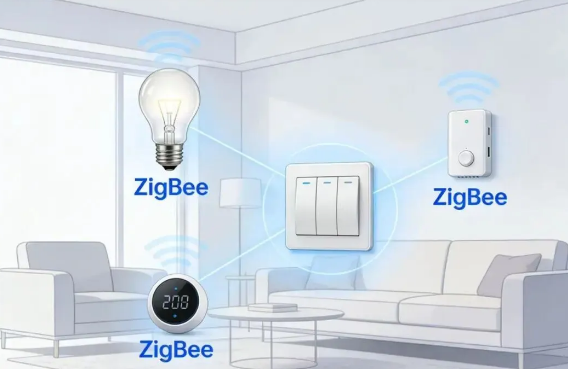
ZigBee adopts the IEEE 802.15.4 standard, with a transmission distance of 10–100 meters and a communication rate of 250 kbps. Its core advantage lies in self-networking capability—multiple devices can relay signals to each other to form a "Mesh network". With a response delay as low as 10–20 milliseconds, it supports one coordinator to connect 254 terminals, perfectly adapting to indoor multi-device linkage scenarios.
As the core communication technology for indoor device linkage in buildings, ZigBee focuses on supporting real-time collaboration of short-range, multi-device systems. Its typical application scenarios include:
Conference room scenario-based control: Deploy ZigBee human body sensors, lighting controllers, and air conditioning panels. When personnel entry is detected, the system automatically triggers linkage to turn on lights (adjusted to 80% brightness), set the air conditioner to 24℃, and lower the projection screen. After personnel leave, all devices can be automatically turned off according to a preset timer, reducing unnecessary energy consumption.
Hotel room intelligent management: Curtain motors, TVs, and card-swiping power-taking modules in guest rooms are networked via ZigBee. When a guest inserts their card, the "check-in mode" is automatically activated, opening the curtains and gradually brightening the lights. During check-out, the "energy-saving mode" is triggered to cut off non-essential power supplies.
Industrial-grade small-scenario linkage: Small fans and temperature-humidity sensors in data center computer rooms are connected through ZigBee. When the local temperature rises, nearby fans are immediately activated to achieve precise cooling, avoiding energy waste caused by global refrigeration.
Ⅳ. 5G: The "High-Speed Real-Time Engine" for High-End Scenarios

Boasting three core advantages—10 Gbps peak data rate, 1-millisecond ultra-low latency, and millions of connections per square kilometer—5G breaks through the performance bottlenecks of traditional wireless technologies. It also supports edge computing deployment, allowing data processing nodes to be deployed locally within buildings, thus ensuring the real-time performance and security of core business operations.
5G primarily underpins high-end scenarios in building automation that demand stringent requirements for speed and latency, serving as the core driving force for upgrading smart buildings toward "deep intelligence":
Digital Twin Collaborative Management
Through 5G, real-time data from thousands of sensors and equipment operating statuses within the building are transmitted to the digital twin platform, achieving millisecond-level synchronization between the virtual model and physical devices. Engineers can remotely debug equipment such as air conditioners and water pumps via the virtual interface.
AI-Powered Intelligent Operation and Maintenance
5G supports the real-time data transmission from devices like high-definition cameras and infrared thermal imagers. Combined with edge computing, it enables AI-driven fault diagnosis (e.g., abnormal fan noise, pipeline leakage), significantly improving diagnostic accuracy and reducing the costs of manual inspections.
High-Concurrency Scenario Scheduling
During large-scale exhibitions, tens of thousands of people gather in the building simultaneously. 5G enables the BMS to collect real-time data on crowd density and elevator operation status. AI algorithms then dynamically optimize elevator scheduling (e.g., increasing car stop frequency during peak hours) and fresh air supply, ensuring comfort and safety in high-density crowd scenarios.