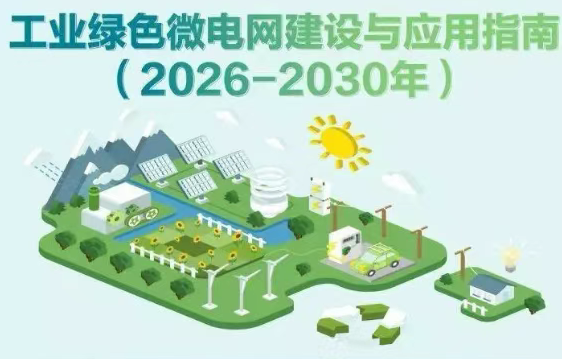
The Guidelines specify that an industrial green microgrid is an integrated system incorporating technologies such as photovoltaic power, wind power, new-type energy storage, and intelligent energy management and control. Its core objective is to drive the transformation of industrial enterprises and parks from energy "consumers" to "prosumers", addressing key pain points in the industrial sector including a high proportion of energy consumption and insufficient absorption of green electricity. Data shows that in 2024, industrial electricity consumption accounted for over 60% of China’s total social electricity consumption. While the number of operational industrial green microgrid projects nationwide has exceeded 300, they are still in the pilot and demonstration phase. Pressing issues such as inconsistent technical standards and inadequate market-oriented mechanisms urgently need to be resolved. The issuance of these Guidelines has, for the first time at the national level, defined the construction principles, models and application scenarios for industrial microgrids, providing systematic guidance for the development of the sector. In terms of core requirements, the Guidelines set forth a number of mandatory indicators and technology-oriented provisions, which are closely integrated with the field of building intelligent control. Among these requirements, the proportion of renewable energy power generation that is locally consumed on an annual basis shall be no less than 60% in principle, and the electricity fed into the grid in regions with a spot market shall not exceed 20% of the total power generation. These "red line" requirements will force enterprises to enhance their load regulation capabilities, while building intelligent control technologies such as AI-based intelligent dispatching and digital twins have become the core pathways to achieve this goal. The Guidelines also emphasize the need to leverage advanced technologies such as artificial intelligence and big data to build a digital energy and carbon management system, strengthening functions including energy efficiency optimization, carbon accounting and load control. This is highly aligned with the current trend of building intelligent control upgrading from single-equipment control to full-domain energy management. In addition, the Guidelines encourage the application of new technologies such as sodium-ion batteries and thermal energy storage, providing a direction for the iteration of terminal equipment in building intelligent control.
The clarification of construction models and application scenarios has brought broad market space for building intelligent control enterprises. The Guidelines propose two models: self-financed and self-constructed, and co-constructed by third parties. These models are not only suitable for large enterprise parks with concentrated energy consumption and stable loads, but also lower the transformation threshold for small and medium-sized enterprises. Among the four key application scenarios, both industrial parks and data centers have strong demand for building intelligent control technologies—industrial parks need to realize multi-enterprise coordination through distributed power generation, shared energy storage and intelligent management and control, while data centers rely on combined cooling, heating and power supply as well as intelligent demand response to meet their high-reliability energy consumption needs. The practice of Jiangsu Changzhou XCR Technology Co., Ltd. has taken the lead in verifying this integration path. The photovoltaic-plus-energy storage system it built achieves "charging during off-peak hours and discharging during peak hours" through AI algorithms and digital twin technology, with a green electricity self-consumption rate of over 60%. It can supply 100% of the entire factory’s electricity demand for 8 hours during peak periods, saving millions of yuan in electricity bills annually.
It is worth noting that the Guidelines explicitly include the utilization of industrial waste energy, the production and utilization of clean hydrogen, among other aspects into the construction scope, expanding new application scenarios for building intelligent control. For example, the by-product gas, waste heat and residual pressure in the steel industry can be linked with building heating and power supply systems through intelligent heat exchange systems to achieve cascade energy utilization. After the implementation of integrated "hydrogen production plus hydrogen utilization" projects, building intelligent control systems can be extended to the full-chain monitoring of hydrogen storage and transportation. In the Tai’an High-tech Industrial Development Zone of Shandong Province, the flexible microgrid project of Taikai High-Voltage Switchgear Co., Ltd. has achieved a 100% local utilization rate of green electricity. Its core lies in the integration of photovoltaic power, energy storage and production loads through a building intelligent control system, which consumes 11 million kWh of green electricity annually and reduces carbon dioxide emissions by more than 9,300 tons.
Industry experts stated that the implementation of the Guidelines will promote the in-depth integration of building intelligent control and industrial energy systems, spawning diversified market demands. On the one hand, the energy-saving renovation of existing projects needs to rely on building intelligent control technologies to optimize dispatching logic and improve the green electricity absorption rate. On the other hand, new projects will strengthen the integrated design of "microgrid plus building intelligent control", forcing enterprises to deploy intelligent management and control systems from the source. Relevant responsible persons from the Ministry of Industry and Information Technology disclosed that the next step will be to carry out publicity and interpretation of the Guidelines, promote the dissemination of typical cases and the improvement of supporting policies, and accelerate the implementation of advanced technologies. With the release of policy dividends, building intelligent control enterprises are expected to seize the initiative in the wave of industrial green transformation by virtue of their digital and intelligent advantages, providing core support for the achievement of the "dual carbon" goals.